
Aviation Engineering
Welcome to the Department of Aviation Engineering. We are one of the newest department of the College of Engineering at Salahaddin University-Erbil the ceremony of opening the department were held on 16th of October 2020(Opens in a new tab/window). The first and second years focus on the maintenance of aircraft at Salahaddin University, while the third and fourth years emphasize the same major in the Royal Jordanian Air Academy College of Engineering started with the Aviation Engineering Department only in the academic year 2020 in Erbil city of Iraqi Kurdistan, during the same year a total of (33) students were accepted. Aviation Engineering Department offers a four-semester B.Sc. engineering at Salahaddin university and the next four semesters of studies in the Royal Jordanian Air Academy. All the expenses of the last two years at the Royal Jordanian Air Academy will be upon the student themselves to pay. The Aviation Engineering Department is under construction. We have a small hall near Mechanical Engineering. A simple explanation about aviation engineering and answering the most common questions.
on Wednesday 17th August 2022 the head of Aviation Engineering department Professor Ayd Akkab with 15 students meet the Assist Professor Dr Kamaran Younis Muhammad Ameen the head of Salahaddin University, with the presence of the head assistant of Salahaddin University for higher education and scientific research, this meeting prepared all the 15 students to travel to the Royal Jordanian Air Academy to continue their academic year there.
As mentioned before the studies at the Royal Jordanian Air Academy will be for two years, and during this period students will only study practical subjects, and students will receive their Bachelor’s certificate from Salahaddin university, and they will receive the certificate of flight from Royal Jordanian Air Academy.
The Royal Jordanian Air Academy was established in 1966 and this university is the first and the largest university for Aviation training in the middle east and Africa (MENA), and the Royal Jordanian Air Academyis approved by the International Civil Aviation Organization(ICAO), and according to the europian safety standards was established.
The students went on a scientific trip to the Academy of flight in Sulaymaniyah on March 4th, 2020.For any other explanations and things you want to know more about, please do not hesitate to contact us on our Facebook page (Opens in a new tab/window)
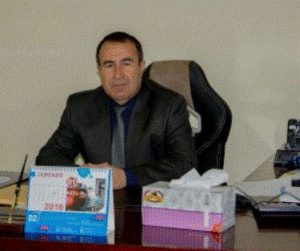
Name:Prof. Dr. Iyd Eqqab Maree
Title: Head of Aviation Engineering Department
Contact Information:
Email: [email protected]
Phone:
Office: Head of Aviation Engineering Department
Social Links: https://academics.su.edu.krd/iyd.maree
Professor Dr. Iyd Eqqab Maree is a distinguished academic and the current Head of the Aviation Engineering Department at Salahaddin University-Erbil, a position he has held since 2020. He is a Professor with a strong background in mechanical engineering, specializing in Aerodynamics, Renewable Energy, and Thermodynamics.
Educational Background:
- B.Sc. and M.Sc. from the University of Technology - Baghdad, Iraq.
- Ph.D. from TU-Freiberg, Germany
. Professional Experience & Leadership: Before leading the Aviation Engineering Department, Professor Maree served as the Head of the Mechanical and Energy Engineering Department from 2015 to 2020. His career also includes significant experience at the Aircraft Engineering Research Center in Baghdad, where he held positions as a researcher and deputy head of the center. This blend of academic leadership and practical research experience in aircraft engineering is highly valuable for the department
. Research Interests: Dr. Maree's research interests span several critical areas, particularly:
- Aerodynamics
- Renewable Energy (including solar collectors, solar air heaters, and geothermal heat pumps)
- Thermal Applied Mechanics
- Computational Fluid Dynamics (CFD)
His publications reflect these interests, with recent work on CFD modeling of solar air heaters with phase change materials and computational studies on two-phase flow.
Teaching Experience: He teaches a range of important subjects at both undergraduate and postgraduate levels, including:
- Aircraft Performance
- Gas Dynamics
- Aircraft Design
- Strength of Materials
- Engineering Mechanics
- Advanced Renewable Energy (Post-graduate)
- Computational Fluid Dynamics (Post-graduate)
- Stress Analysis (Post-graduate)
Contributions to the Department: As Head of the Aviation Engineering Department, Professor Maree plays a pivotal role in shaping the curriculum, fostering research, and guiding students. His expertise in aerodynamics and renewable energy is particularly relevant as the aviation industry increasingly focuses on sustainability and advanced aircraft design. His leadership helps ensure that the department's programs remain current and prepare graduates for the evolving demands of the global aviation sector.
Professor Dr Iyd Eqqab Maree
Email : [email protected]
The mission of the Department of Aviation Engineering is to provide quality education to prepare nationally and internationally competitive undergraduate students for a successful career in Aviation engineering; to provide advanced skills and knowledge in Aerodynamic, Engine, and Fuel in sub-areas of Aviation engineering for graduate students; and to provide service to the university, engineering profession, and the public. The objectives are: 1-To ensure that graduates will have a mastery of fundamental knowledge, problem-solving skills, engineering experimental abilities, and capabilities necessary for entering an Aviation engineering career and/or graduate school. 2-To produce graduates that have the knowledge and skills necessary for identifying and assessing design alternatives and the related social, economic, environmental, and public safety impacts. 3-To produce graduates who have verbal and written communication skills necessary for successful professional practice. 4-To prepare graduates to function effectively on teams. 5-To prepare graduates for professional licensure, leadership roles, and life-long learning.
As part of its future developments plans, the Department of Aviation Engineering preparing to launch postgraduate and higher diploma programs in 2025-2026
VisionThe Department of Aviation Engineering will try to develop internationally prominent educational and research programs in cooperation with our students, to ensure sustainable prosperity and quality of life. The department will also excel in undergraduate and graduate instruction, research in all sub-areas of Aviation engineering in the near future, and service to the public consistently. The Department will make significant contributions to the social development of the region and nation, through our leadership in engineering education.
Aviation Engineering departments typically aim to produce graduates who are well-rounded professionals capable of contributing to various aspects of the aviation industry. Here's a breakdown of common learning outcomes:
Core Engineering Knowledge and Application:
- Fundamental Sciences:
A strong understanding of physics, mathematics, chemistry, and other basic sciences relevant to aeronautical engineering (e.g., fluid mechanics, thermodynamics, electrical and electronic principles, solid mechanics).
- Aeronautical Principles: In-depth knowledge of key theoretical and
applied principles of aeronautical engineering, including:
o Aerodynamics: Understanding how aircraft interact with air, principles of lift, drag, and flight performance.
o Propulsion: Knowledge of different types of aircraft engines (jet, piston, rocket) and their operation, performance, and maintenance.
o Aircraft Structures and Materials: Ability to analyze, design, and assess the integrity of aircraft structures, including knowledge of advanced materials and manufacturing processes.
o Flight Mechanics, Stability, and Control: Understanding aircraft motion, stability characteristics, and control systems.
o Avionics and Aircraft Systems: Knowledge of aircraft electrical, electronic, communication, navigation, surveillance, and flight guidance systems.
- Engineering Design: Ability to apply engineering design methodologies to produce solutions that meet specified needs, considering factors like public health, safety, welfare, global, cultural, social, environmental, and economic impacts. This includes:
o Designing new aircraft and their systems.
o Upgrading existing designs
. o Preparing design documentation.
- Problem-Solving and Analysis: Ability to identify, formulate, and solve complex aviation engineering problems using appropriate methods, tools, and equipment, including analytical, computational, and modeling techniques (e.g., using software like Matlab, Mathcad).
- Experimentation and Data Analysis: Ability to plan and conduct practical research and testing of aircraft, systems, and elements,
process and assess experimental data, and interpret results to formulate conclusions.
Practical Skills and Industry Relevance:
- Aircraft Maintenance and Repair: Competence in evaluating, performing maintenance, assembly, fabrication, and repair work on aircraft structures, power plants, and avionics systems, adhering to technical manuals, safety regulations, and industry standards.
- Troubleshooting and Diagnostics: Ability to diagnose malfunctions and defects in aircraft systems and components using technical manuals, drawings, and diagnostic equipment.
- Compliance and Regulations: Understanding and applying national and international aviation regulations, standards, and certification processes (e.g., related to airworthiness, safety).
- Modern Tools and Technologies: Proficiency in using modern engineering tools, simulation software, and computer-aided design (CAD) for analysis, optimization, and design.
Professional and Soft Skills:
- Communication: Effective written, spoken, and visual communication skills for diverse audiences, including technical reporting and presentations.
- Teamwork and Collaboration: Ability to function effectively in multidisciplinary teams, collaborate with professionals from other disciplines, and demonstrate leadership.
- Ethical and Professional Responsibility: Recognition of ethical and professional responsibilities in engineering situations, making informed judgments that consider societal and environmental impacts of engineering solutions.
- Critical Thinking: Ability to apply a systematic approach to solve problems and use various thinking skills to anticipate and address challenges.
- Lifelong Learning: Recognition of the need for continuous professional
development and the ability to acquire and apply new knowledge using appropriate learning strategies.
- Project Management: Understanding of project management aspects, including economic considerations and risk assessment in project development and implementation.
- Global and Societal Context: Understanding the impact of engineering solutions in a global, economic, environmental, and societal context, including sustainable aviation practices.
These learning outcomes collectively prepare graduates for a wide range of careers in the aviation industry, including aircraft design, manufacturing, maintenance, research and development, air traffic management, and regulatory bodies.
Types of Partnerships:
- Industry Collaboration (Airlines, Manufacturers, MROs, Tech Companies):
o Internships and Co-op Programs: Structured placements for students to gain practical experience.
o Joint Research and Development Projects: Collaborating on specific challenges, such as developing new materials, optimizing aircraft performance, or improving maintenance procedures.
o Curriculum Development and Review: Industry experts provide input to ensure the curriculum meets industry needs, covering emerging technologies and skills gaps.
o Guest Lecturers and Workshops: Industry professionals share their expertise and insights with students.
o Equipment and Software Donations: Companies provide the department with access to specialized tools, software, or even retired aircraft components for training.
o Capstone Projects/Senior Design Projects: Students work on real-world problems provided by industry partners.
o Professional Training: Universities may offer customized training programs for industry employees.
- Government and Regulatory Bodies (Civil Aviation Authorities, Ministries of Transport):
o Policy and Regulation Research: Collaborating on studies that inform aviation policy and safety regulations.
o Certification Support: Departments might assist in the testing and certification of new technologies or processes.
o Safety Initiatives: Working together to promote aviation safety and develop best practices.
. o Workforce Development: Addressing national needs for skilled aviation professionals.
- Research Institutions and Other Universities: o Joint Research Initiatives: Combining expertise and resources for larger-scale research projects.
o Student and Faculty Exchange Programs: Allowing cross pollination of ideas and experiences.
o Shared Facilities: Utilizing specialized labs or equipment that might be unique to another institution.
o Consortia and Centers of Excellence: Forming multi institutional groups focused on specific areas of aviation research (e.g., sustainable aviation, advanced air mobility).
- Professional Organizations (e.g., AIAA, RAeS, ICAO)
o Student Chapters: Encouraging student engagement in the broader aviation community.
o Networking Events: Facilitating connections between students, faculty, and industry professionals.
o Conferences and Workshops: Co-hosting events to disseminate research and foster discussion.
o Mentorship Programs: Connecting students with experienced professionals.
Examples of Successful Partnerships:
- University of Birmingham & Rolls-Royce: A long-standing collaboration focusing on advanced metallic alloys for aeroengines, contributing to significant advancements in efficiency and sustainability.
- Khalifa University & Dassault Aviation: An MoU for aeronautical education and research, including student sponsorships, internships, and collaborative research programs on smart and advanced materials.
- Kaunas University of Technology (KTU) & Lithuanian Aviation Companies: The "Avia Praktika" program provides students with up to four years of practical experience, aligning their studies with EASA requirements and preparing them for the industry.
- University of Doha for Science and Technology (UDST) & Airbus, ENAC, ISAE-SUPAERO, Qatar Airways: A comprehensive MoU covering joint academic programs, research collaboration, and internship opportunities to advance aeronautics education in Qatar.
In conclusion, forging strong and diverse partnerships is not just a nice-to have for an Aviation Engineering department; it's a strategic imperative that ensures the relevance, quality, and impact of its programs and graduates in a competitive global industry.
Degree program overview: undergraduate studies in the aviation engineering department
An undergraduate degree program in Aviation Engineering (often also called Aeronautical Engineering or Aerospace Engineering, with slight variations in focus) provides students with the fundamental knowledge and skills required to design, develop, maintain, and operate aircraft and related systems. These programs typically span four years and lead to a Bachelor of Science (B.Sc.) or Bachelor of Engineering (B.Eng.) degree
. Here's a general overview of the curriculum structure and key areas of study:
- Foundational Years (Years 1 & 2): The initial years focus on building a strong foundation in core sciences and fundamental engineering principles.
- Mathematics:
o Calculus (Differential, Integral, Multivariable)
o Linear Algebra
o Differential Equations
o Probability and Statistics
o Numerical Methods
- Physics:
o Mechanics (Statics and Dynamics) o Thermodynamics
o Electromagnetism
o Waves and Optics
- Chemistr:
o General Chemistry, often with a focus on materials science.
- Computer Science and Programming:
o Introduction to programming languages (e.g., Python, MATLAB,, C++)
o Computational tools and software applications for engineering
o Computer-Aided Design (CAD) principles
- Engineering Fundamentals:
o Engineering Graphics/Drawing
o Introduction to Engineering Design
o Basic Electrical and Electronics Engineering
o Materials Science and Engineering (properties of metals, polymers, composites)
o Fluid Mechanics (basic principles)
o Manufacturing Processes
- Specialized Aviation Engineering Core (Years 2, 3 & 4):
These years delve deeper into the specific disciplines of aviation engineering.
- Aerodynamics:
o Incompressible and Compressible Flow
o Airfoil and Wing Theory
o Lift and Drag Analysis
o Boundary Layer Theory
o Computational Fluid Dynamics (CFD) (introduction)
- Propulsion Systems:
o Thermodynamics of jet engines (turbojets, turbofans, turboprops)
o Piston engines for aircraft
o Rocket propulsion (introduction)
o Engine performance analysis and design
Aircraft Structures and Materials;
o Mechanics of Solids (stress, strain, elasticity)
o Structural Analysis (beams, trusses, thin-walled structures)
o Aerospace Materials (aluminum alloys, titanium, composites, smart materials)
o Fatigue, Fracture, and Damage Tolerance
o Aircraft Structural Design principles
- Flight Mechanics, Stability, and Control:
o Aircraft Performance (takeoff, landing, climb, range, endurance)
o Static and Dynamic Stability
o Flight Control Systems (classical and modern control theory)
o Aircraft Dynamics (equations of motion)
- Avionics and Aircraft Systems:
o Aircraft electrical and electronic systems
o Navigation, Communication, and Surveillance (CNS) systems
o Flight Management Systems (FMS)
o Flight Instruments and Displays
o Autopilot systems
- Aircraft Design:
o Conceptual and Preliminary Aircraft Design
o System Integration
o Design optimization, often involving team-based capstone projects.
- Aviation Regulations and Safety:
o Introduction to national and international aviation regulations (e.g., ICAO, EASA, FAA)
o Airworthiness standards and certification processes
o Aviation safety management systems
o Human factors in aviation
III. Electives and Specializations (Years 3 & 4):
Students often have the opportunity to choose elective courses based on their interests and career aspirations. Common specialization areas include:
- Aircraft Maintenance Engineering
- Aerospace Manufacturing
- Unmanned Aerial Vehicles (UAVs)/Drones
- Spacecraft Design and Space Systems (if the program has an "Aerospace" focus)
- Computational Methods in Aerospace
- Aeroelasticity
- Aeroacoustics
- Advanced Materials and Composites
- Air Traffic Management
- Aviation Management and Economics
- Practical and Professional Components:
- Laboratory Work: Extensive hands-on experience in aerodynamics labs (wind tunnels), structures labs (material testing), propulsion labs, and avionics labs.
- Design Projects: Integrated design projects throughout the curriculum, culminating in a significant senior design or capstone project where students work in teams to design an aircraft or a major aircraft system.
or require internships with aviation companies, airlines, MRO (Maintenance, Repair, and Overhaul) facilities, or research institutions to gain real-world experience.
- Seminars and Workshops: Exposure to industry trends, guest speakers, and professional development. Learning Approach: A typical Aviation Engineering program combines:
- Lectures and Tutorials: Delivering theoretical knowledge and problem-solving techniques.
- Laboratory Sessions: Providing practical experience and validating theoretical concepts.
- Computer Simulations and Modeling: Using industry-standard software for design, analysis, and simulation.
- Team-Based Projects: Fostering collaboration, communication, and project management skills.
- Individual Research/Design Projects: Developing independent problem-solving and critical thinking.
Graduates from such programs are prepared for diverse roles in the aviation industry, including aircraft design, manufacturing, maintenance, research and development, airworthiness certification, and operations.
A comprehensive curriculum for an Aviation Engineering department (often leading to a Bachelor of Science or Bachelor of Engineering degree) in Erbil, Iraq, would generally follow international standards while incorporating local context and potential specializations. It's typically a four-year program, with some institutions extending to five years for additional practical training or a more in-depth specialization.
Bachelor of Science/Engineering in Aviation Engineering
Program Duration: 4 Years (8 Semesters) Total Credit Hours: Typically between 240-250 ECTS credits (or equivalent US credits).
Department of :- Aviation
Study program modules
|
|
FIRST SEMESTER |
||
|
|
Module Name( course, subject) |
Credit |
Hours |
|
1 |
General English |
2 |
4 |
|
2 |
Information Technology |
3 |
3 |
|
3 |
Academic Debate |
2 |
4 |
|
4 |
Kurd ology |
3 |
4 |
|
5 |
Engineering Drawing |
3 |
4 |
|
6 |
Mathematics I |
6 |
4 |
|
7 |
Workshop Technology |
3 |
4 |
|
8 |
History of World Aviation |
3 |
3 |
|
9 |
Engineering Mechanics |
5 |
5 |
|
|
|
Total |
35 |
|
|
|
|
|
|
|
3rd SEMESTER |
||
|
|
Subjects |
Credit |
Hours |
|
1 |
Aircraft Design and Maintenance |
3 |
4 |
|
2 |
Gas dynamic |
4 |
6 |
|
3 |
Aircraft Propulsion |
4 |
6 |
|
4 |
Flaw detection and non-destructive methods of control of aircraft and aircraft engine |
3 |
4 |
|
5 |
Aircraft stability and Control |
4 |
5 |
|
6 |
Measurements and Instrumentation |
3 |
4 |
|
7 |
Pneumatics and Hydraulics |
3 |
4 |
|
8 |
Aviation Security and Flight safety Management System |
3 |
5 |
|
9 |
Aircraft performance |
3 |
5 |
|
|
|
Total |
43 |
.
|
|
||||||
|
|
|
|
|
|
||
|
|
Second SEMESTER |
|
||||
|
|
Subjects |
Credit |
Hours |
|
||
|
1 |
Strength of Materials |
3 |
4 |
|
||
|
2 |
Engineering Mathematics |
3 |
4 |
|
||
|
3 |
Aviation fuel and lubricants and environmental aspects of them use |
3 |
5 |
|
||
|
4 |
Aerospace Materials |
3 |
4 |
|
||
|
5 |
Aerodynamics |
3 |
5 |
|
||
|
6 |
Fluid Mechanics |
5 |
5 |
|
||
|
7 |
Solid work |
3 |
4 |
|
||
|
8 |
General English II |
3 |
4 |
|
||
|
9 |
Thermodynamics |
4 |
4 |
|
||
|
|
|
Total |
39 |
|
||
.
|
|
|
|
|
|
||
|
|
8 SEMESTER |
|
||||
|
|
Subjects |
Credit |
Hours |
|
||
|
1 |
Airfield |
3 |
3 |
|
||
|
2 |
Ensuring Environmental safety of Aviation Activities |
6 |
3 |
|
||
|
3 |
Fundamental of Airport Radar System |
3 |
3 |
|
||
|
4 |
Mechanical Vibration |
3 |
3 |
|
||
|
5 |
Power devices of unmanned aircraft |
3 |
3 |
|
||
|
6 |
Airport technology management |
3 |
3 |
|
||
|
7 |
Aero elasticity |
3 |
3 |
|
||
|
8 |
Automatic control |
4 |
3 |
|
||
|
9 |
Fluid Mechanics |
4 |
4 |
|
||
|
10 |
Heat Transfer |
3 |
3 |
|
||
|
|
|
Total |
31 |
|
||
.
Admissions
Admission to the Aviation Engineering Department at Salahaddin University Erbil (SUE), like other public universities in the Kurdistan Region of Iraq, is primarily governed by the Ministry of Higher Education and Scientific Research (KRG) and follows a central admission system. Here's a breakdown of the typical admission requirements and process for undergraduate studies in Aviation Engineering in Erbil, focusing on SUE:
- General Admission Requirements for Iraqi/Kurdish Students:
- High School Diploma (12th Grade National Exam Certificate): This is the most crucial requirement. Applicants must have completed their secondary education (12th grade or equivalent) with recognized credentials from a scientific stream.
o Scientific Branch: Aviation Engineering falls under the scientific stream, meaning applicants must have studied subjects like Physics, Chemistry, and Mathematics in their preparatory (high) school.
o Minimum GPA/Average: Engineering departments, especially specialized ones like Aviation Engineering, typically have a higher minimum GPA or average score required from the 12th grade national exam. For Salahaddin University-Erbil's College of Engineering, the minimum GPA for Year 12 National Exam can be as high as 85%.
o Specific Subject Scores: There's often a requirement for combined scores in specific subjects. For example, SUE's College of Engineering states that "the sum of Physics and Mathematics grades of the Year 12 national Exam no less than 180.
"
- 2. Iraqi Nationality: Generally, applicants must hold Iraqi nationality.
- 3. Age Limit: For morning (regular) studies, there might be an age limit (e.g., typically under 24 or 25 years old). Graduates of previous 15 academic years may be eligible if they haven't been centrally admitted elsewhere.
- 4. Medical Examination: Applicants must pass a medical examination toensure they are fit for university study, particularly for fields like engineering.
- 5. Full-Time Study Commitment: Students must commit to full-time study. Combining employment with morning studies is generally not permitted without official study leave.
- 6. Application Form: Submission of an official application form, often through an online portal managed by the Ministry of Higher Education and Scientific Research (Central Admission) or the university directly for "Parallel Study" or "Evening Study" programs.
- Admission Process (Central Admission System):
- Electronic Application: The primary method of application is through the Ministry's electronic portal.
- Choice Selection: Students list their preferred colleges and departments in order of priority. It's crucial to select Aviation Engineering as a top choice if it's the desired field.
- Merit-Based Selection: Students are selected based on their 12th grade national exam scores and the availability of seats. The competition for engineering fields, especially Aviation Engineering, is usually high due to limited capacities and high demand.
- Admission Notice: Successful candidates receive an admission letter and proceed with registration at the university
Graduate > Alumni
The Aviation Engineering Department at Salahaddin University-Erbil (SUE) is a relatively new department, having been established and opened on October 16, 2020.
This means that the first cohort of students would have started their studies in the academic year 2020-2021. Given that it's a four-year program, the first batch of graduates from the Aviation Engineering Department at SUE would have completed their studies in the summer of 2024.
Therefore, the department is just beginning to build its alumni network.
Where will these graduates likely go?
The graduates of SUE's Aviation Engineering Department are equipped for a range of roles within the growing aviation sector, particularly in Iraq and the Kurdistan Region. Based on the curriculum and partnerships, potential career paths for these early alumni include:
- Aircraft Maintenance and Overhaul (MRO): Working with airlines or independent MRO companies to maintain, repair, and troubleshoot aircraft and their systems. Given the department's emphasis on maintenance in the early years and potential for practical training, this is a very strong avenue.
- Airlines: Roles in technical operations, engineering support, quality assurance, and maintenance planning for airlines operating in Iraq (e.g., Iraqi Airways) and potentially regional carriers.
- Airports: Positions in airport operations, infrastructure maintenance, and ground support services.
- Government Aviation Authorities: Working with the Iraqi Civil Aviation Authority (ICAA) or the Kurdistan Regional Government's aviation bodies on airworthiness, safety regulation, and certification.
- Aerospace Manufacturing (Limited in Iraq, but potential for future growth/international opportunities): While Iraq's aerospace manufacturing industry is nascent, graduates with strong design and 17 materials knowledge could pursue opportunities with international aerospace companies or future local initiatives.
- Research and Development: Contributing to academic or industrial research in areas like aerodynamics, propulsion, or new materials.
- Further Education: Pursuing postgraduate studies (Master's or Ph.D.) in specialized areas of aviation or aerospace engineering, either locally or internationally.
- Consulting: Providing technical expertise to aviation-related projects. Building the Alumni Network: As a new department, SUE's Aviation Engineering Department will likely focus on:
- Tracking Graduates: Maintaining a database of its alumni and their career paths.
- Alumni Association: Establishing an active alumni association to foster connections among graduates and with the department.
- Networking Events: Organizing events for alumni to network with current students and industry professionals.
- Mentorship Programs: Facilitating mentorship relationships between experienced alumni and current students.
- Industry Feedback: Utilizing alumni feedback to continuously improve the curriculum and ensure its relevance to industry needs.
The first few batches of graduates will be pioneers, and their successes will be crucial in establishing the reputation and future prospects of the Aviation Engineering Department at Salahaddin University-Erbil.
The topic of graduate employability for the Aviation Engineering Department at Salahaddin University-Erbil (SUE) is particularly interesting because the department is relatively new, having opened on October 16, 2020. This means the first cohort of graduates would have just completed their studies in the summer of 2024 (as of July 2025). Therefore, direct statistics on their employment are not yet widely available
. However, we can make strong predictions and observations based on several factors:
- Factors Favoring Employability in the Kurdistan Region and Iraq:
- Growing Aviation Sector:
o Increased Air Traffic: Recent reports indicate a significant and unprecedented increase in air traffic through Iraqi airspace, with over 700 flights crossing daily. This suggests a revitalized and confident aviation sector.
o Strategic Location: Iraq's geographic position as a strategic air corridor between East and West, and a central hub in global aviation, means continued demand for aviation services.
o Airport Development: The presence of international airports in Erbil, Sulaimaniyah, and Kirkuk, along with ongoing infrastructure improvements, necessitates skilled personnel for operations, maintenance, and expansion.
o Government Focus: The KRG and Iraqi government have expressed commitment to developing the aviation sector and creating job opportunities.
- 2. Specialized Local Demand:
o Lack of Local Graduates: SUE's Aviation Engineering Department is one of the first of its kind in the Kurdistan Region and perhaps Iraq with such a comprehensive focus. This means graduates will fill a significant void in the local talent pool.
o Aircraft Maintenance (MRO) Focus: The department's curriculum, particularly in the initial years, emphasizes aircraft maintenance. This aligns directly with a major need for airlines and MRO facilities to ensure airworthiness and operational efficiency.
o Language Advantage: Graduates proficient in English (the medium of instruction) and local languages (Kurdish, Arabic) will have a distinct advantage in the local job market.
- 3. University's Reputation and Partnerships:
o Salahaddin University-Erbil is a reputable public university.
o The department's stated intent for the latter two years of study to potentially involve practical subjects with institutions like the Royal Jordanian Air Academy (or previously Ukrainian National Aviation Engineering University) could provide valuable practical exposure and international networking. This would significantly enhance employability.
- Potential Employment Sectors for Graduates:
- Airlines: Iraqi Airways, local and regional carriers operating into Erbil and Sulaimaniyah (e.g., FlyErbil, various international airlines with technical operations). Roles would include:
o Aircraft Maintenance Engineers/Technicians (B1/B2 license track)
o Technical Services Engineers
o Planning and Control Engineers
o Quality Assurance/Control Engineers
- Maintenance, Repair, and Overhaul (MRO) Facilities: Dedicated MRO centers (either independent or airline-affiliated) would be prime employers.
- Airports and Ground Operations:
o Airport Operations Managers (entry-level support roles)
o Ground Support Equipment Maintenance
o Facilities Engineering
- Civil Aviation Authorities:
o Airworthiness Inspectors
o Safety Regulators
o Certification Engineers
o Investigators (accident/incident)
- Aerospace Industry (Limited in Iraq): While large-scale aircraft manufacturing isn't present, graduates could find roles in:
o Local defense or specialized engineering companies that might service aviation components.
o Internationally, if they seek opportunities abroad with major aerospace manufacturers (Airbus, Boeing, Lockheed Martin, etc.) or their supply chains.
- Consulting Firms: Specializing in aviation safety, operations, or design.
- Academia and Research: Some graduates may pursue higher education (Master's, Ph.D.) and eventually join academic institutions or research centers.
III. Challenges and Considerations:
- Local Market Size: While growing, the aviation industry in Iraq and the KRI is smaller than in highly developed economies. The number of available highly specialized engineering roles might be limited initially.
- Competition (from other engineers): Graduates will compete with mechanical or electrical engineers who may have some transferable skills, though the aviation engineers will have a specialized advantage.
- Licensing: For certain roles (e.g., Licensed Aircraft Engineer), further practical experience and specific certifications (EASA Part-66 or
equivalent) will be required after graduation, which the university prepares them for.
- Economic Stability: The overall economic and political stability of the region can influence investment in the aviation sector and, consequently, job availability. Recent airspace closures due to regional tensions highlight this vulnerability.
- International Opportunities: Many aviation engineering graduates globally seek opportunities in major aerospace hubs (e.g., USA, UK, Europe, UAE). SUE graduates, especially with practical international exposure from the proposed partnerships, would be competitive for such roles if they choose to emigrate.
Conclusion: Given the growing aviation sector in Iraq and the Kurdistan Region, the specialized nature of the Aviation Engineering degree from SUE, and the emphasis on practical skills, the employability prospects for graduates are expected to be strong and promising, particularly for roles in aircraft maintenance, airline operations, and regulatory bodies within the region. The first few graduating classes will be instrumental in demonstrating the value of this new program to the local industry.
Providing comprehensive student resources is vital for any engineering department, especially a new and specialized one like Aviation Engineering at Salahaddin University-Erbil (SUE). These resources support academic success, personal well-being, and career development. Based on general university practices and specific information available for SUE, here's an overview of student resources likely available to Aviation Engineering students:
- Academic Resources:
- 1. Faculty and Staff:
o Academic Advising: Each student is typically assigned an academic advisor (a faculty member) who provides guidance on course selection, academic progress, career paths, and general university life. This is crucial for navigating the demanding Aviation Engineering curriculum.
o Office Hours: Professors hold regular office hours for students to ask questions, seek clarification on lectures, or discuss course material individually.
o Teaching Assistants (TAs): For larger courses, TAs may provide additional support through tutorials, lab sessions, and grading.
- 2. Laboratories and Workshops:
o The Aviation Engineering Department at SUE has invested in specialized labs, which are critical for practical learning: § Aerodynamics Laboratories: Featuring subsonic wind tunnels (vertical and horizontal), aerodynamic trainers for experiments on flow around bodies, velocity measurement, boundary layer analysis, and flight demonstration.
- Aircraft Engines Laboratories: Including cut sections of turbojet engines and gas turbine jet engine trainers for hands-on study of propulsion systems.
- Fluid Laboratories: Apparatus for measuring discharge through nozzles, and demonstrating thermodynamics and fluid mechanics of air expansion.
- Fuel Laboratories: Equipment for measuring freezing point, flash point, viscosity, combustion rate, and energy produced by fuel.
o Computer Labs: Access to computers with specialized engineering software (e.g., CAD, CFD, FEA, MATLAB, simulation tools) essential for design, analysis, and research.
o General Engineering Workshops: Shared workshops within the College of Engineering for practical skills in manufacturing processes, basic electrical/electronics, and hands-on project work
. 3. Library and Information Resources:
o Salahaddin University Central Library: Provides a vast collection of physical books, journals, and periodicals.
o E-Library (SULIB): An electronic library system recently completed at SUE (as of April 2025), offering digital access to books, academic journals (including open-access journals), and potentially e-theses and research projects. This is invaluable for accessing up-to-date engineering literature
. o Departmental Resources: The Aviation Engineering Department might also maintain a smaller, specialized collection of aviation-specific textbooks, manuals, and technical reports for easy student access
. 4. Online Learning Platforms
o Universities often use Learning Management Systems (LMS) like Moodle or Google Classroom where professors upload lecture notes, assignments, announcements, and supplementary materials. o The university's IT Center provides support for academic staff and likely for students regarding digital resources and email.
Career and Professional Development Resources:
1. Career Development Center (CDC): Salahaddin University-Erbil has a dedicated CDC that aims to:
o Bridge the gap between the university and industry.
o Prepare students for the labor market through internships, training, workshops, and seminars
. o Provide assistance with resume writing, cover letters, and interview skills.
o Organize job fairs and connect students with potential employers in the Kurdistan Region.
o Promote entrepreneurship and professional development.
o This center would be a key resource for Aviation Engineering students seeking internships and jobs.
- Industrial Training/Internships: The curriculum explicitly mentions industrial training/internships. The department and CDC would assist students in securing placements with airlines, MRO facilities, airports, or relevant companies.
- Guest Lectures and Seminars: The department likely invites industry professionals to deliver guest lectures, providing students with insights into real-world applications, industry trends, and networking opportunities.
III. Student Support Services:
- 1. Student Life Office/Activities Unit: The College of Engineering has a "Student Life" section that highlights opportunities for student activities, promoting teamwork, networking, and leadership skills.
- Health and Counseling Services: While specific details for the Aviation Engineering Department aren't always provided, universities typically offer health clinics and counseling services to support student well being.
- IT Support: The university's IT Center provides technical support for network access, university email, and other digital services.
- Quality Assurance Office: Oversees the quality of education and student feedback mechanisms, ensuring continuous improvement of services.
- Student Organizations and Clubs:
- While specific Aviation Engineering student clubs aren't explicitly listed on the SUE website (as of now), engineering colleges usually encourage or have student chapters of professional organizations (e.g., local chapters inspired by AIAA - American Institute of Aeronautics and Astronautics, or local engineering associations). These provide:
o Networking opportunities.
o Project-based learning (e.g., building drones).
o Participation in competitions.
o Leadership development.
Key Point from SUE's Aviation Department page:
"The first and second years focus on the maintenance of aircraft at Salahaddin University, while the third and fourth years emphasis the same major in Royal Jordanian Air Academy. All the expenses of the last two years at the Royal Jordanian Air Academy will be upon the students themselves to pay."