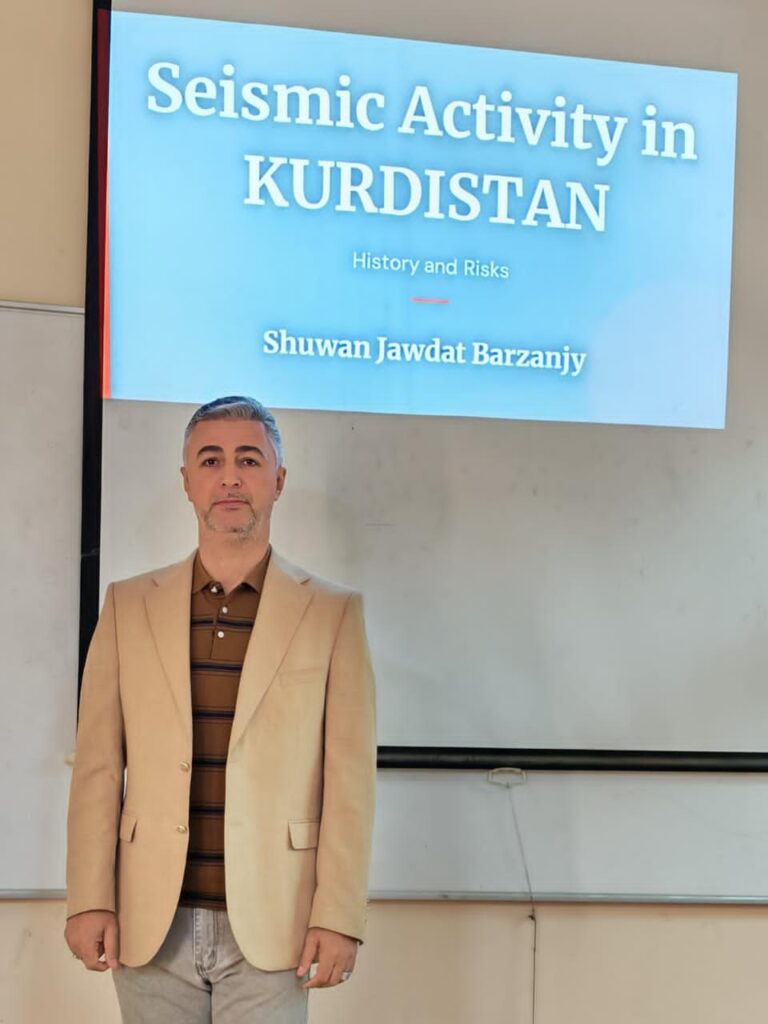
Water Resources Department
Presenter:
Shuwan Jawdat Barzanjy.
Kurdistan is situated in a highly seismic area, formed by the
interaction of the Arabian, Eurasian, and Anatolian tectonic plates.
The ongoing collision of these plates creates significant geological features, such as the Zagros and Taurus mountains, and makes the region prone to powerful earthquakes, particularly along the Zagros Fold-Thrust Belt .
Historically, Kurdistan has experienced several significant earthquakes. The 2017 Kermanshah earthquake (Mw 7.3) was notably devastating, leading to over 600 fatalities and extensive damage. The 1991 Erbil/Sorān earthquake (Mw 5.5) prompted increased awareness regarding urban planning in the Kurdistan Region of Iraq (KRI). Evidence from ancient structures such as the Temple of Anahita and statues on Mount Nemrut indicates that the region has a long history of seismic activity.Currently, assessing seismic risk is crucial, with most major cities—Erbil, Sulaymaniyah, and Duhok—located in “medium” to “high” hazard zones. There is approximately a 10% probability of experiencing
damaging earthquakes over the next 50 years. Rapid urban growth has contributed to vulnerabilities, particularly concerning the older infrastructure, with studies indicating that about 10% of buildings in Duhok may be at risk of collapse during seismic events. Additionally, the mountainous landscape increases the risk of secondary hazards like landslides that can disrupt accessibility and emergency services.In response, local governments are adopting stricter building codes
and enhancing seismic monitoring systems. However, the prevalence of older, non-reinforced masonry constructions poses significant challenges to safety; particularly as many earthquakes in this region are shallow, leading to more intense surface damage than deeper quakes of similar magnitudes.
30/04/2026