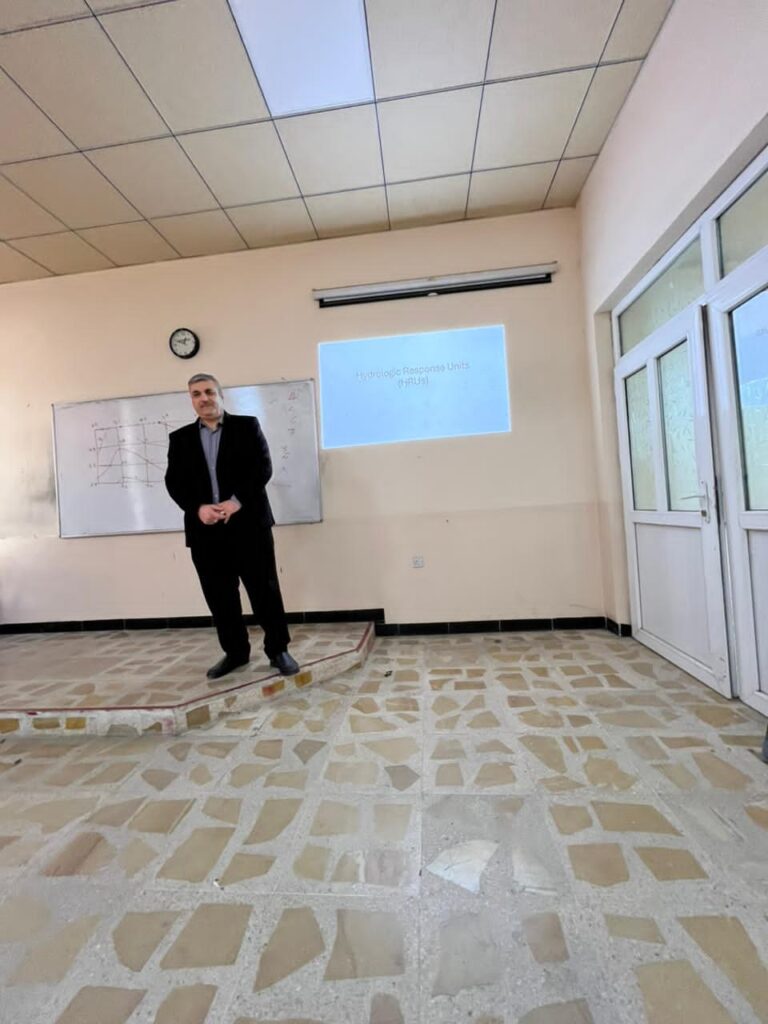
Presenter:Dr.Abdulwahid Ali qasm
Water resources department
Date 11/2/2026
Hydrological Response Unit (HRUs)is a fundamental, homogeneous unit used in watershed modeling, created by overlaying maps of land use, soil type, and land slope. HRUs represent areas expected to behave similarly in response to weather events, enabling the simulation of water, sediment, and nutrient loading, particularly in tools like SWAT
HRUs are created by overlaying maps of land use, soil, and slope in GIS to create distinct, relatively homogeneous areas.They serve as the smallest unit for calculating hydrological processes, with results aggregated to calculate total watershed output.
They are used to simulate water balance, predict pollutant loading, and identify hotspot areas for environmental management.
Components are:
Soil Type: Affects infiltration and storage.
Land Use/Cover: Influences evapotranspiration and runoff.
Slope: Determines velocity of overland flow.
Spatial Nature: While based on map data, HRUs in models like SWAT are not necessarily contiguous, meaning they can represent similar land types scattered throughout a watershed,.
HRUs are critical for understanding how different parts of a landscape react to climate and land-use changes.